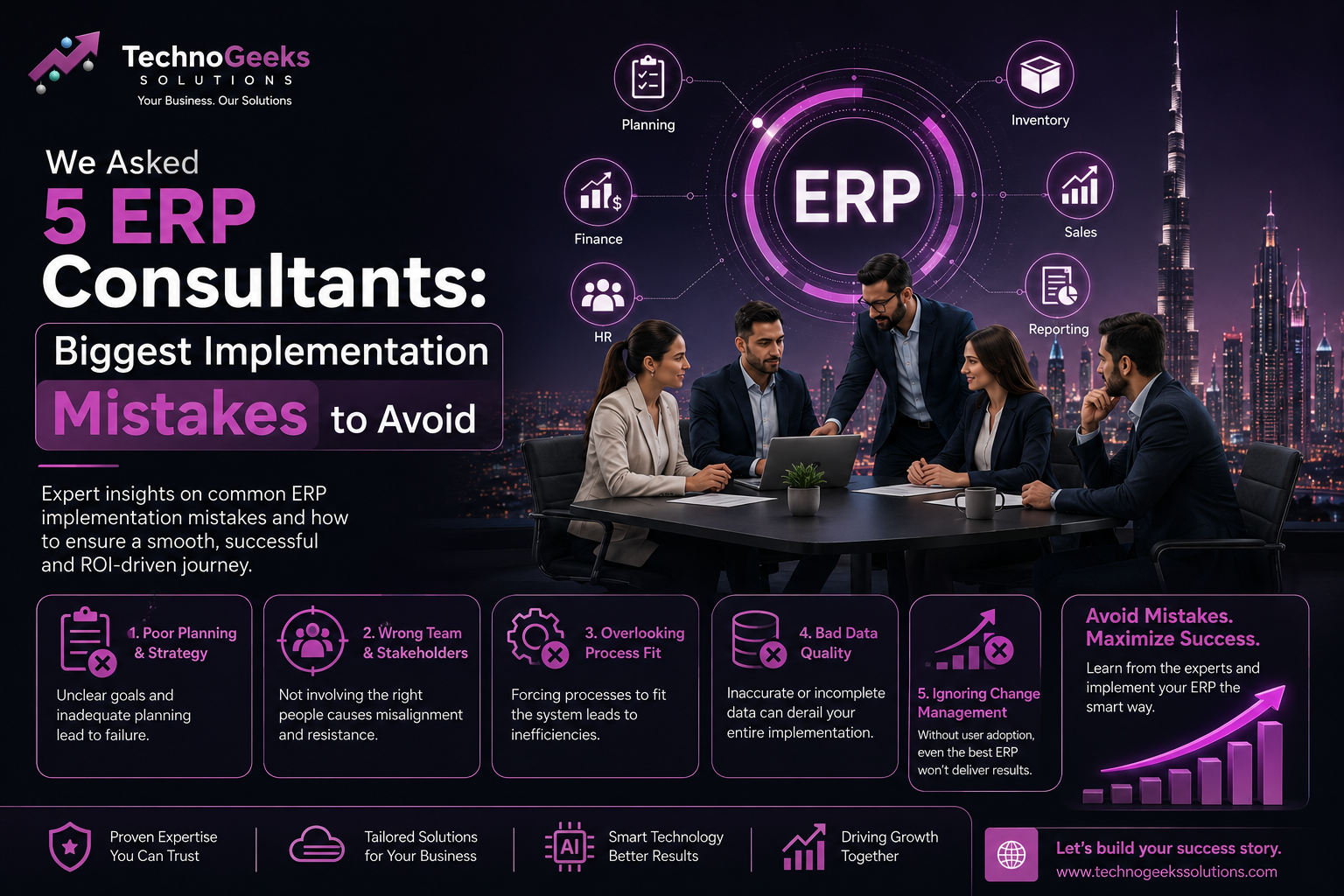
We spoke with five ERP consultants who work with SMEs and enterprises across the UAE to find out what actually derails ERP implementation Dubai projects not in theory, but in the messy reality of go-live day. Their answers were strikingly consistent, and a little uncomfortable for anyone about to start a rollout.
Every year, Dubai businesses invest serious money into ERP systems expecting smoother operations and every year, a chunk of those projects run over budget, over time, or get quietly abandoned six months in. So we went straight to the source.
If you’re planning an ERP project this year, treat this as your pre-flight checklist.
Why ERP Projects Fail More Often Than They Should | ERP implementation Dubai
Before we get into the specifics, here’s the uncomfortable truth our panel agreed on: most ERP failures aren’t caused by bad software. They’re caused by bad planning.
Dubai’s SME sector has embraced digital transformation faster than most regions, but speed without preparation is exactly where ERP consultants Dubai businesses hire tend to see the same five mistakes play out, project after project.
Let’s go through them one by one.
Mistake #1: Skipping the Process Audit
The consultant’s take: “The biggest mistake I see is businesses trying to digitize a broken process. If your approval chain is chaotic on paper, it’ll be chaotic in the ERP too just faster and harder to fix.” Senior ERP Advisor, Dubai-based implementation firm
Jumping straight into software selection without mapping your actual workflows is like renovating a house without checking the foundation first.
What to do instead:
- Document your current processes end-to-end before touching any software
- Identify bottlenecks and redundant approval steps
- Decide what should change before implementation, not during
Mistake #2: Choosing ERP Software for the Wrong Reasons
The consultant’s take: “Business owners often pick a platform because a competitor uses it, or because a sales rep gave a great demo. Neither of those tells you if it fits your business.” ERP Solutions Consultant, UAE
This is one of the most common traps for businesses evaluating ERP software for SME’s Dubai has to offer there’s no shortage of options, but fit matters more than brand recognition.
Questions to ask before choosing:
- Does it integrate with your existing CRM, accounting, and inventory tools?
- Can it scale as your business grows across the UAE or wider GCC?
- Is local support available, or are you relying on an overseas team?
- What does year two pricing look like, not just the launch offer?
Mistake #3: Underestimating Change Management
The consultant’s take: “Technically the system worked. But three months in, half the team was still using the old spreadsheet on the side because nobody explained why the change mattered.” Business Process Consultant
This is arguably the most overlooked issue in business process automation Dubai projects. Software adoption isn’t just a technical rollout it’s a people problem.
How to fix it:
- Involve department heads early, not just at the training stage
- Explain the “why” behind the change, not just the “how”
- Appoint internal champions in each department to support the transition
- Expect a dip in productivity for 2–4 weeks and plan for it
Mistake #4: No Clean Data Migration Plan
The consultant’s take: “Garbage in, garbage out. We’ve seen companies migrate ten years of messy, duplicated customer records straight into a new system and then wonder why reporting is unreliable.” Data & Systems Consultant, Dubai
Data migration is where timelines quietly blow out. It’s rarely glamorous, which is exactly why it gets rushed.
Before migrating, teams should:
- Audit and clean existing data (remove duplicates, fix inconsistent formatting)
- Decide what historical data is actually worth migrating vs. archiving
- Run a test migration before the full switch
- Assign clear ownership for data accuracy post-launch
Mistake #5: Treating Go-Live as the Finish Line
The consultant’s take: “Go-live is the start, not the end. The businesses that get real value are the ones still refining workflows and running reviews six months later.” ERP Project Manager, Dubai
Too many businesses treat the launch date as the project’s conclusion, then wonder why the ROI isn’t showing up.
Post-launch essentials:
- Schedule a 30/60/90-day review to catch friction points early
- Track specific KPIs time saved, error reduction, reporting speed
- Keep a feedback channel open for staff using the system daily
- Revisit workflows quarterly as the business evolves
What This Means If You’re Planning an ERP Rollout in Dubai
Put these five mistakes together and a pattern emerges: successful ERP implementation has less to do with the software itself and more to do with the planning, people, and process work around it.
A few quick self-check questions before you start:
- Have we mapped our current processes honestly, including the messy parts?
- Are we choosing software based on fit, not familiarity?
- Do we have a real change management plan, not just a training session?
- Is our data clean enough to migrate with confidence?
- Do we have a plan for the first 90 days after go-live?
If any of these feel shaky, it’s worth bringing in an experienced partner before you sign a contract the cost of getting expert input upfront is almost always lower than the cost of fixing a failed rollout later.
Final Thoughts
ERP implementation doesn’t fail because the technology isn’t good enough it fails because the groundwork gets skipped under pressure to move fast. The consultants we spoke with all pointed to the same root cause: rushing process, people, and data decisions to hit a launch date.
Get those three right, and the software does exactly what it’s supposed to.
Planning an ERP rollout for your Dubai business? Talk to Technogeeks Solutions for a free process audit before you commit to a platform it’s the step our consultants say gets skipped the most, and costs the most when it is.
FAQs
1. What is the most common reason ERP implementations fail in Dubai?
Poor planning specifically, skipping a proper process audit and change management strategy is cited more often than software limitations by consultants working across the UAE.
2. How long does a typical ERP implementation take for a Dubai SME?
Depending on complexity, most SME implementations take 6–12 weeks from process mapping to go-live, with an additional 30–90 days of post-launch refinement.
3. Should I clean my data before or after ERP migration?
Always before. Migrating incomplete or duplicated data into a new system creates reporting problems that are far harder to fix once the system is live.
4. Do I need an ERP consultant, or can I implement it myself?
Smaller, simple rollouts can sometimes be self-managed, but most businesses benefit from consultant input at the process-mapping and vendor-selection stages, where the costliest mistakes tend to happen.
5. What should I check before choosing ERP software for my business?
Confirm it integrates with your existing CRM and accounting tools, offers local UAE support, and fits your actual workflows not just the features shown in a sales demo.